



How Airbnb Hosts Can Reduce Operating Costs Without Cutting Quality
Running an Airbnb or holiday let is not just about getting bookings. Profit depends on what is left after cleaning, laundry, maintenance, supplies, utilities, fees, repairs, restocking and your own time.
The mistake many hosts make is trying to cut costs in ways guests can see. Cheap towels, missing basics, tired kitchen items or poor cleaning may save money briefly, but they can damage reviews and reduce repeatability.
The better approach is to reduce hidden waste, simplify changeovers and standardise the supplies that are replaced every stay.
This guide explains how Airbnb hosts, holiday-let owners and property managers can reduce operating costs without making the guest experience feel cheaper.
Start with the right principle: cut waste, not quality
Cost reduction should not mean removing things guests value.
Guests still expect the basics: a clean property, fresh linen, towels, soap, toilet roll, kitchen essentials and a space that feels properly prepared. Airbnb encourages hosts to provide essential amenities such as toilet paper, soap, towels, pillows and linen. You can read Airbnb’s guidance here: providing essential amenities for guests.
The better cost-saving question is not: “What can I remove?”
It is: “Where am I wasting money without improving the guest experience?”
The main Airbnb operating costs hosts should track
Before cutting costs, you need to know where the money is going.
Common Airbnb and holiday let operating costs include:
- Cleaning and changeover labour
- Laundry
- Guest consumables
- Kitchen and bathroom supplies
- Welcome packs
- Utilities
- Repairs and maintenance
- Replacement linens and towels
- Platform and payment fees
- Insurance
- Software and channel management tools
- Waste, recycling and local services
For most hosts, the fastest improvements come from cleaning, consumables, stock control and maintenance prevention.
Use cost per stay, not monthly spend
Monthly costs can hide the real picture. A better metric is cost per stay.
For example:
- Cleaning cost per stay
- Laundry cost per stay
- Guest consumables cost per stay
- Welcome pack cost per stay
- Average maintenance cost per stay
This helps you see whether a short two-night stay is actually profitable after turnover costs.
If a property has 80 stays per year and you reduce waste by £3 per stay, that is £240 per year from one small improvement. Across 10 properties, that becomes £2,400 per year.
1. Standardise your repeat supplies
Repeat supplies are where small costs multiply.
These include:
- Toilet roll
- Hand soap
- Washing-up liquid
- Sponges or washing-up items
- Dishwasher tablets
- Bin liners
- Tea towels
- Guest toiletries
- Tea, coffee and sugar
If every property uses different products, your operation becomes harder to manage. Cleaners have to make judgement calls, stock checks take longer, and emergency purchases become more common.
Standardisation reduces waste, improves consistency and makes ordering easier.
2. Set minimum stock levels
Running out of supplies is expensive. It creates emergency supermarket trips, cleaner delays and poor guest experience.
Each property should have minimum stock levels for core consumables.
Example:
- Toilet roll: minimum 8 rolls
- Bin liners: minimum 10
- Dishwasher tablets: minimum 10
- Guest washing-up items: minimum 10 stays’ worth
- Hand soap: minimum one backup refill
- Tea towels: minimum two clean sets
For property managers, this should be handled centrally. Do not rely on cleaners buying random supplies at the last minute.
3. Stop overfilling cupboards
Overstocking looks safe, but it can create hidden costs.
Overfilled cupboards cause:
- Duplicate purchasing
- Lost stock
- Messy changeovers
- Cleaner confusion
- Guests using more than intended
- Products expiring or becoming damaged
The goal is not maximum stock. The goal is controlled stock.
A tidy, countable supply area is more useful than a cupboard full of random extras.
4. Reduce cleaning friction
Cleaning is often one of the largest repeat costs in short-term rental operations.
You should not cut cleaning quality. But you can reduce cleaning friction.
Ways to do this:
- Use a room-by-room checklist.
- Keep cleaning products in one clear place.
- Use the same turnover sequence every time.
- Provide photo examples of how each room should look.
- Separate cleaner-use supplies from guest-facing supplies.
- Ask cleaners to report low stock before it becomes urgent.
Airbnb’s host ground rules say listings should be clean before check-in and that guest turnover should include cleaning between every stay. You can read the guidance here: Airbnb ground rules for home hosts.
For a deeper system, read: Holiday Let Turnover Guide: How Professional Hosts Reset Faster.
5. Make laundry more predictable
Laundry costs rise when linen is poorly managed.
Common issues include:
- Too many mismatched towel sets
- Unclear linen rotation
- Replacing lightly marked items too quickly
- Not treating stains fast enough
- Losing stock between properties
Better laundry control:
- Use the same towel colours across properties.
- Keep a clear par level for each property.
- Use mattress and pillow protectors.
- Train cleaners to report stains immediately.
- Replace linen on condition, not guesswork.
Cheap linen is usually false economy. Durable, easy-to-wash linen often performs better over time.
6. Review your welcome pack cost
Welcome packs can improve the arrival experience, but they need a cost ceiling.
A good welcome pack should feel thoughtful, not excessive.
Cost-saving options:
- Use one strong local item instead of several small packaged items.
- Avoid products with heavy packaging.
- Use refillable or bulk tea and coffee where appropriate.
- Use a reusable tray or basket for presentation.
- Keep the setup consistent across properties.
If your welcome pack costs £6 per stay and you host 100 stays per year, that is £600 per property. Reducing that to £4 without reducing perceived quality saves £200 per property per year.
For more ideas, read: Sustainable Welcome Pack Ideas for Airbnb and Holiday Lets.
7. Reduce kitchen consumable waste
The kitchen is one of the easiest places to save money without guests feeling a downgrade.
Focus on:
- Refillable washing-up liquid
- Clear stock levels for dishwasher tablets
- Fresh guest-ready washing-up items
- Reusable cloths for housekeeping teams
- Controlled tea, coffee and sugar portions
- Clear recycling and food waste instructions
The important point is presentation. Guests should still feel that the kitchen is clean, well stocked and ready to use.
For the full kitchen setup, read: Airbnb Kitchen Essentials Checklist: What Hosts Should Provide.
Smarter stock control
Small guest supplies should be easy to store, count and replace
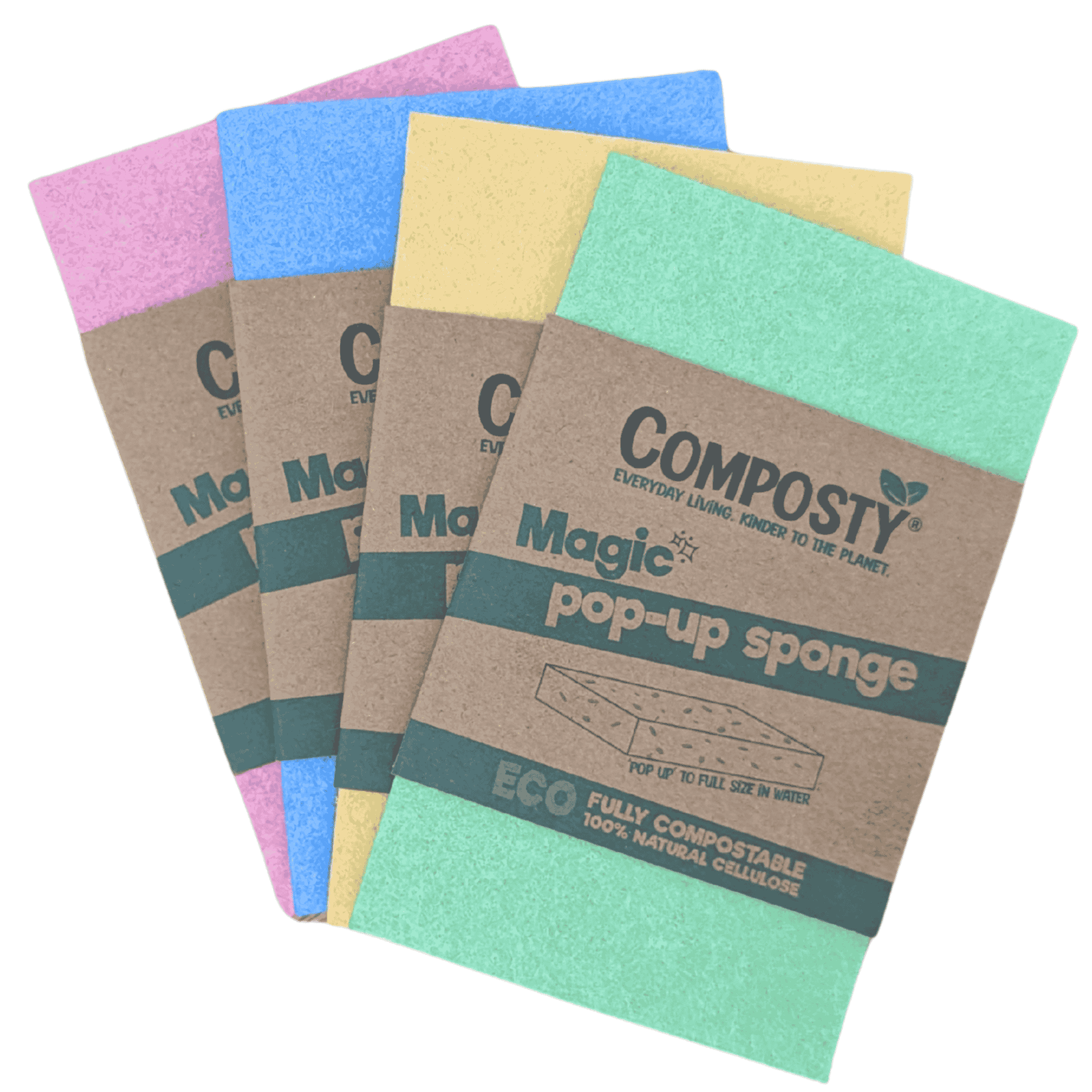
Sponges are a small item, but they are replaced repeatedly across holiday let turnovers. Loose or bulky stock can make cupboard management harder and presentation less consistent.
Composty pop-up sponges arrive flat, are individually sleeved, and are designed for guest-ready kitchen resets. They are plastic-free, compostable after use, and easy to store between changeovers.
Less cupboard bulk. Better presentation. Simpler restocking.
8. Cut emergency purchasing
Emergency purchasing is one of the easiest costs to reduce.
It usually happens when:
- Stock levels are unclear.
- Cleaners buy what is convenient.
- Hosts do not track repeat items.
- Different properties use different supplies.
- There is no reorder point.
Emergency purchases tend to be more expensive, less consistent and less efficient.
The fix is simple: standardise, centralise and reorder before stock runs low.
9. Prevent small maintenance issues becoming expensive
Reactive maintenance is more expensive than preventive maintenance.
Build a monthly inspection checklist covering:
- Leaks under sinks
- Loose handles
- Slow drains
- Loose toilet seats
- Damaged grout or sealant
- Marks on walls
- Wobbly chairs or tables
- Appliance faults
- Light bulbs and batteries
- Heating and ventilation issues
A £5 fix ignored for three months can become a guest complaint, refund request or emergency callout.
10. Reduce energy waste without annoying guests
Energy saving should be invisible or simple.
Good options include:
- LED lighting
- Clear heating instructions
- Draught reduction
- Smart thermostats where appropriate
- Appliances with sensible energy performance
- Reminder notes that are helpful, not bossy
Do not make guests feel uncomfortable to save a small amount. Comfort still matters.
11. Track damage and replacement costs
Hosts often track booking revenue but not replacement patterns.
Track how often you replace:
- Towels
- Bed linen
- Glassware
- Cookware
- Tea towels
- Soft furnishings
- Cleaning tools
- Guest consumables
This shows whether certain products are poor value or whether guests are repeatedly damaging specific items.
12. Be careful with sustainability claims
Sustainable choices can reduce waste and improve presentation, but avoid vague claims you cannot support.
The UK Green Claims Code says environmental claims should be accurate, clear and backed by credible evidence. You can read the guidance here: Green Claims Code guidance.
Use specific claims instead:
- “Refillable hand soap.”
- “Clearly labelled recycling.”
- “Plastic-free kitchen sponge.”
- “Compostable after use.”
- “Bulk ordering to reduce excess packaging.”
Specific language is more credible and safer.
Airbnb cost-saving checklist
Use this checklist to reduce costs without damaging guest experience.
- Track cost per stay, not just monthly spend.
- Standardise repeat consumables.
- Set minimum stock levels.
- Stop overfilling cupboards.
- Reduce emergency purchasing.
- Use refillable products where practical.
- Improve laundry stock rotation.
- Review welcome pack cost per stay.
- Use cleaner photo proof after turnovers.
- Build a monthly maintenance checklist.
- Track replacement costs.
- Protect visible guest basics.
What not to cut
Some cost cuts are not worth it.
Do not cut:
- Cleaning quality
- Fresh linen
- Towels
- Soap
- Toilet roll
- Kitchen basics
- Clear guest instructions
- Maintenance response speed
- Anything that affects safety
Guests are usually more forgiving of simple decor than poor cleanliness, missing essentials or avoidable inconvenience.
Cost-saving priorities for property managers
If you manage multiple holiday lets, focus on systems rather than one-off savings.
Your biggest levers are:
- Centralised stock ordering
- Standardised guest supplies
- Cleaner checklists
- Photo proof
- Bulk purchasing
- Minimum stock levels
- Maintenance tracking
- Cost per stay reporting
The larger the portfolio, the more small operational improvements compound.
Final thought
The best Airbnb cost savings do not come from making the stay feel cheaper. They come from making the operation more controlled.
Reduce duplicate stock. Reduce emergency buying. Reduce bulky storage. Reduce waste from repeat consumables. Reduce missed maintenance. Reduce cleaner uncertainty.
Protect the guest-facing basics, then cut the hidden inefficiencies behind them.
FAQs
What are the biggest operating costs for Airbnb hosts?
The biggest operating costs usually include cleaning, laundry, utilities, maintenance, guest supplies, platform fees, insurance, replacements and restocking.
How can Airbnb hosts reduce costs without hurting reviews?
Hosts should reduce operational waste rather than visible guest quality. Focus on stock control, repeat consumables, cleaning efficiency, laundry rotation, preventive maintenance and bulk purchasing.
Should Airbnb hosts cut welcome packs to save money?
Not necessarily. A better approach is to simplify the welcome pack, set a cost ceiling and choose fewer, better items with less packaging.
How can property managers reduce short-term rental costs?
Property managers should standardise supplies, centralise ordering, set minimum stock levels, use cleaner photo proof and track cost per stay across properties.
What should Airbnb hosts not cut?
Do not cut cleaning quality, fresh linen, towels, soap, toilet roll, basic kitchen supplies, safety items or maintenance response speed.
What is the easiest Airbnb cost-saving improvement?
The easiest starting point is stock control. Standardise repeat supplies, set minimum levels and reduce emergency purchasing.